
Alex and Claire | Above the Fray
There is always room for hope; it will fit better if you leave a little space for it.
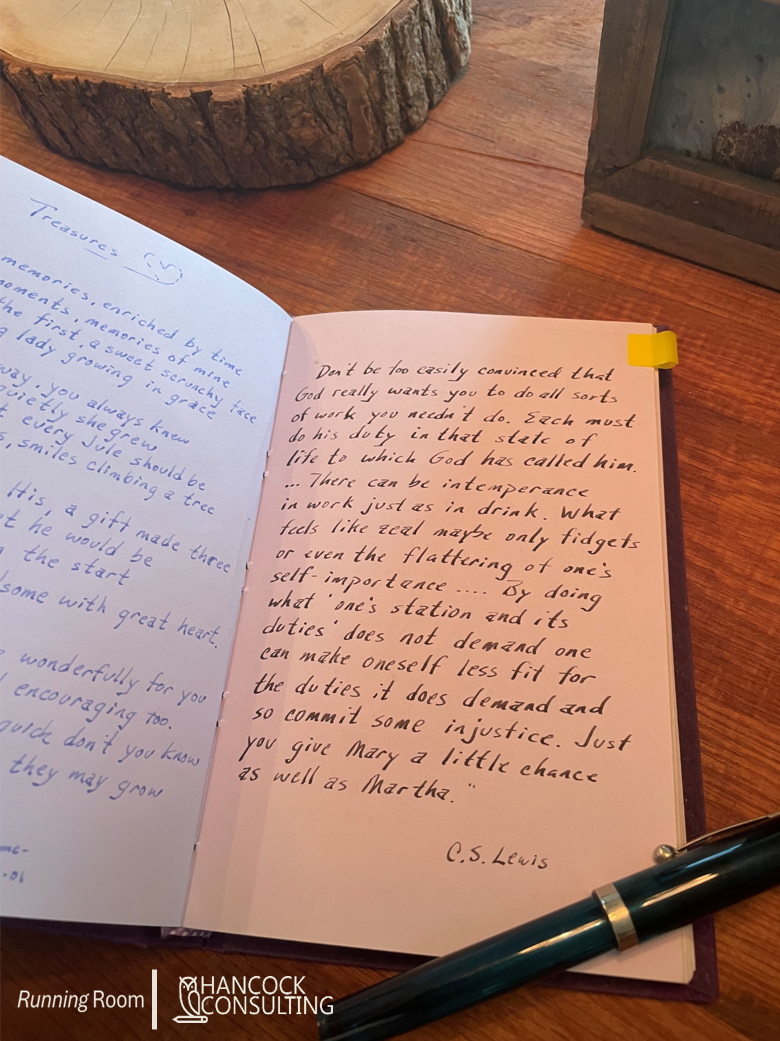
Many years ago, I bought a blank journal,
a purple hardback with no lines,
the favorite color of one of my children.
I filled its pages with pieces and drawings of wisdom:
some mine,
most borrowed from those who said things better than I did.
It was meant for their future selves,
for when life’s complexity settles in
like an uninvited guest who plans to stay.
I imagined them passing the journal
from one sibling to another
when one was struggling and needed oriented -
or grounding - in what really matters.
A quiet reminder that even when life branches out,
the roots of a father can still hold.
Looking back,
that journal became something else.
It showed me how ordered love works:
words given now for
someone you love to stand on later.
It also revealed the risk:
when the better things
are postponed for the busy things
the pages fill
but hearts can empty.
Silence becomes full
of what we meant to say.
I do not remember how I stumbled on the excerpt
that underpins the story of Alex and Claire.
A line of truth that hit before I knew why.
A line that has come back many times over the years.
It came from a letter C. S. Lewis wrote
to a woman named Mary Shelburne,
a woman he never met.
We are afforded a glimpse into their exchange;
careful where you step,
there are tender plants growing
among the sage of oaks.
C. S. Lewis wrote:
“…don't be too easily convinced that God really wants you to do all sorts of work you needn't do. Each must do his duty in that state of life to which God has called him. ...there can be intemperance in work just as in drink. What feels like zeal may be only fidgets or even the flattering of one's self-importance.... by doing what one's station and its duties does not demand one can make oneself less fit for the duties it does demand and so commit some injustice. Just you give Mary a little chance as well as Martha"
(Letter to Mary Shelburne, 28 November 1953)
At first glance,
a warning about overwork.
But the deeper cut is this:
You can lose the best things
by giving the wrong things
your best energy.
Good work can steal from better love.
What is urgent can rob what is sacred.
You can win the day
and lose the ones who wanted to share it.
I know something of that.
Broken years.
Decisions that looked noble until the light changed.
I did it.
I was there.
Even now, next steps sometimes feel hollow —
the air thin, the horizon unclear.
My hope is not in me or us; the players.
It is in the Playmaker.
Restoration, my hope, distant and worthy – is a daily prayer.
Just as with Alex and Claire,
their restoration is now more possible than ever.
Some may wonder about Mary and Martha,
they come from Luke 10:38–42.
Two women doing good things
until the Good Himself arrives
and reveals the best thing
amongst the good and better things.
Presence over production.
And later, in John 11,
Martha moves first.
She goes out to meet the arriving Healer.
Her heart has changed direction.
Her love has found its timing.
So, where do we stand?
Are we skirting the selfless best
to taste the sweetness of selfish good?
Are we rationalizing best intentions
as a salve for self-inflicted wounds?
Hardest to see in ourselves,
what quiet pangs are those we love trying to show us?
Do we hear them?
Do we hear the sound only our spirit can catch -
the low rush of an unseen waterfall just around the bend?
We are learning
that the Better Thing
is not always a choice we missed,
but a choice we can still make.
Even now.
Especially now.
